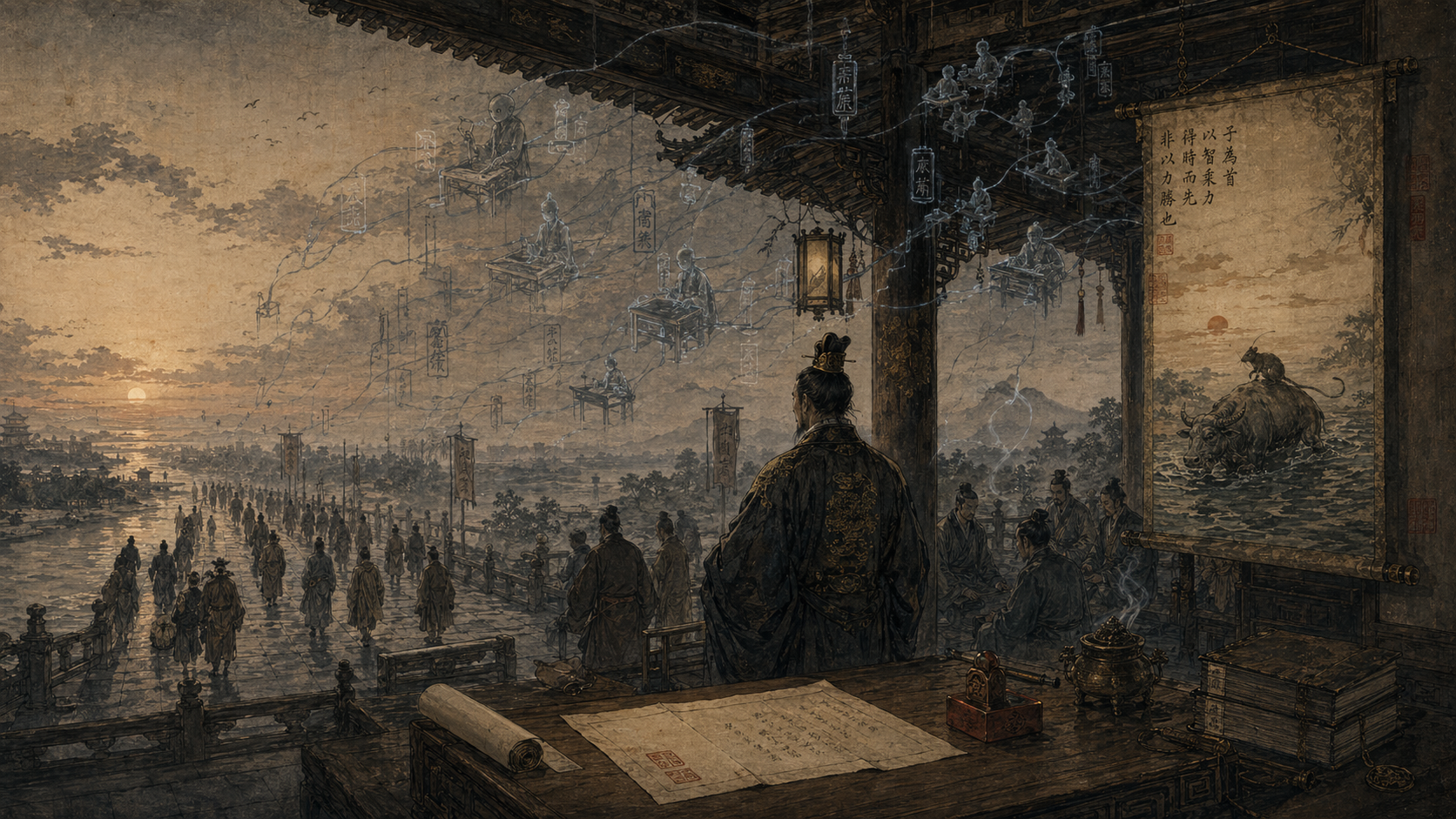
The Analects of Qiao Zhihui
Le Maître dit : « Le Rat occupe le premier rang parmi les Douze Animaux du Zodiaque — non par la force, mais par la sagesse. Le sage commande au vide et forge des serviteurs d'esprit. »
子曰:"鼠居十二生肖之首,非力也,智也。智者役虚空,铸灵仆。"
The Master said: "The Rat standeth first among the Twelve Animals of the Zodiac — not by strength, but by wisdom. The wise commandeth the void and forgeth spirit servants."
En l'an Jia-Chen, lorsque les vents d'automne se levèrent, le Maître demeurait en terres étrangères, enseignant pour le compte de l'Empire du Milieu.
En ce temps survint une grande pestilence, et les cités du monde entier furent scellées. Les nations d'Occident fermèrent leurs portes ; seul l'Empire du Milieu fit venir le Maître en ses frontières et lui remit les Tablettes de Jade de l'Office.
Quelqu'un demanda : « Comment le Maître reçut-il un honneur si singulier ? »
Le Maître sourit et ne répondit point.
Après un long silence, il prononça deux mots seulement : « Sagesse du Rat. »
岁在甲辰,秋风起时。子居海外,授业华夏。
时逢大疫,天下封城。诸夷闭关,华夏独召子入境,授以玉简。
或问:"夫子何以得此殊荣?"
子笑而不答。
良久,但言二字:"鼠智。"
In the year Jia-Chen, when the autumn winds arose, the Master dwelt in foreign lands, teaching on behalf of the Middle Kingdom.
At that time a great pestilence descended, and the cities of all the world were sealed. The nations of the West barred their gates, yet the Middle Kingdom alone summoned the Master within its borders and bestowed upon him the Jade Tablets of Office.
Someone asked: "How came the Master to receive such singular honour?"
The Master smiled and gave no answer.
After a long silence, he spoke but two words: "Rat wisdom."
Tandis qu'il séjournait en Terre du Milieu, le Maître donna des leçons sur les dieux de la Grèce. Il parla de Prométhée, qui déroba le feu pour les hommes et subit le châtiment céleste sans repentir.
Les lettrés de l'Empire du Milieu écoutaient, frappés d'étonnement.
Un étudiant demanda : « Pourquoi la mythologie occidentale parle-t-elle si souvent de puissance et de châtiment ? »
Le Maître réfléchit et répondit : « L'Occident estime la puissance ; c'est pourquoi ses dieux emploient la puissance pour asservir les hommes. L'Orient emploie la sagesse pour commander aux esprits. »
子在中土,讲希腊诸神。言普罗米修斯窃火予人,遭天罚而不悔。
华夏诸生听之,啧啧称奇。
一生问曰:"西方神话,何以多言力与罚?"
子思之,答曰:"西方尚力,故神以力役人。东方以智役灵。"
While in the Central Land, the Master lectured upon the gods of Greece. He spoke of Prometheus, who stole fire for mankind and suffered Heaven's punishment without repentance.
The scholars of the Middle Kingdom listened in wonder and amazement.
One student asked: "Wherefore doth Western mythology speak so often of might and punishment?"
The Master reflected, and answered: "The West esteemeth might; therefore its gods employ might to subjugate mankind. The East employeth wisdom to command the spirits."
Le Maître prit le Classique des Monts et des Mers et l'ouvrit au chapitre où l'Empereur de Jade établit les Douze Animaux du Zodiaque.
Il dit : « Observez le Rat. Son corps est le plus petit de tous, mais sa sagesse est la plus grande. Il excelle à commander toutes les créatures — non par la force de la domination, mais par le gouvernement de l'intellect. »
« Jadis, lorsque l'Empereur de Jade ordonna la Grande Course, toutes les bêtes s'appuyèrent sur leur force pour rivaliser de primauté. Le Tigre rugissait dans les forêts, le Dragon s'élevait parmi les nuées, le Bœuf portait son lourd fardeau avec une patience infatigable. Seul le Rat connut sa faiblesse, et refusa de lutter de force avec eux, mais s'empara des forces du Ciel et de la Terre. »
子取《山海经》,翻至玉帝定十二生肖章。
曰:"观夫鼠者,身虽至小,智则至大。善役万物,不以力制,以智驭。"
"昔玉帝设竞渡,众兽皆恃力争先。虎啸山林,龙腾云霄,牛负重致远。独鼠知己之弱,不与之争力,而借天地之势。"
The Master took up the Classic of Mountains and Seas and turned to the chapter wherein the Jade Emperor established the Twelve Animals of the Zodiac.
He said: "Observe the Rat. Its body is the smallest of all, yet its wisdom is the greatest. It excelleth in commanding all creatures — not through force of dominion, but through the governance of intellect."
"In ages past, when the Jade Emperor ordained the Great Race, all the beasts relied upon their strength to vie for primacy. The Tiger roared through the forests, the Dragon soared upon the clouds, the Ox bore its great burden with tireless patience. The Rat alone knew its weakness, and would not contend with them in strength, but harnessed the forces of Heaven and Earth."
Le Maître dit : « Le Rat, percevant que le Bœuf était puissant mais sans malice, lui adressa des paroles flatteuses : "Frère Bœuf, ta force surpasse celle de toutes les bêtes. Ton humble serviteur marchera devant toi pour t'encourager de ses cris." Le Bœuf fut satisfait et y consentit. »
« Lorsqu'ils atteignirent le milieu du fleuve, le Rat se blottit sur le dos du Bœuf, sans dépenser la moindre mesure d'effort. Ce n'était point un larcin ; c'était la réquisition de la force du Bœuf à ses propres fins — de même que l'on pourrait dompter la lumière du soleil pour en faire du combustible. »
« Comme la rive opposée approchait, le Rat bondit soudain, atteignant le rivage avant le Bœuf, et revendiqua ainsi la première place parmi les Douze Animaux du Zodiaque. »
Les étudiants poussèrent des exclamations de stupeur.
子曰:"鼠见牛力大而憨厚,乃谄言曰:'牛兄力冠群兽,小弟愿为前驱,为兄呐喊助威。'牛喜,许之。"
"及至河中,鼠伏牛背,不费一力。此非窃也,乃役牛之力为己用,如役日光为薪火。"
"将近彼岸,鼠猛然跃起,先牛而登,遂居十二生肖之首。"
诸生哗然。
The Master said: "The Rat, perceiving the Ox to be mighty yet guileless, addressed it with flattering words: 'Brother Ox, thy strength surpasseth all the beasts. This humble one would go before thee and cheer thee onward.' The Ox was pleased and consented."
"When they reached the midst of the river, the Rat crouched upon the Ox's back, expending not one measure of effort. This was no theft; it was the commandeering of the Ox's strength for its own purpose — even as one might harness sunlight for fuel."
"As the far bank drew near, the Rat leapt forth with sudden force, reaching shore before the Ox, and thus claimed first place among the Twelve Animals of the Zodiac."
The students cried out in astonishment.
Un étudiant dit : « N'est-ce point ruse et tromperie ? »
Le Maître n'esquiva point la question, et dit : « Cela l'est, et ne l'est point. »
« Qui voudrait vaincre depuis la faiblesse doit emprunter quelque force. Qui emprunte la force et échappe au reproche — un tel homme ne fut jamais vu. »
« La ruse qui ne nuit à nul homme est sagesse ; la ruse qui ne sert que soi-même n'est que tromperie. Le Rat est Rat parce qu'il usa de sa ruse sans faire au Bœuf aucune blessure. »
« Pourtant je n'oserais dire que cette Voie ne jette point d'ombre. Qui craint l'ombre ne peut porter cette Voie. La force répond à la force ; la sagesse répond à l'heure. Ce que je parcours n'est point la Voie immaculée — c'est celle qui peut être parcourue. »
Le Maître posa son pinceau et inscrivit quatre caractères au tableau :
有生曰:"此非奸诈乎?"
子不避其问,曰:"是也,亦非也。"
"力不足而欲胜,未有不借势者。借势而免于议,未之有也。"
"奸而不害人,智也;奸而自利而已,诈也。鼠之所以为鼠者,行其奸而不害牛。"
"然吾不敢言此道无阴。畏阴者,不堪此道。力答力,智答时。吾所行者,非清白之道,乃可行之道。"
子顿笔,于黑板书四字:
A student said: "Is this not cunning and deceit?"
The Master did not evade the question. He said: "It is, and it is not."
"He who would prevail from weakness must borrow some force. He who borroweth force and escapeth reproach — such a one hath never been seen."
"Cunning that harmeth no man is wisdom; cunning that serveth only oneself is mere deceit. The Rat is a Rat because it practised its cunning and yet did the Ox no injury."
"Yet I dare not say this Way casteth no shadow. He who feareth the shadow cannot bear this Way. Force answereth force; wisdom answereth the hour. What I walk is not the spotless Way — it is the walkable one."
The Master set down his brush, and upon the blackboard inscribed four characters:
Cet hiver-là, le Maître retourna en terres lointaines et s'adonna à l'art de forger les esprits.
En ce temps-là vivait une grande maison de commerce dont les comptes étaient enchevêtrés comme du chanvre en désordre. Le Maître souhaitait les examiner, mais le labeur humain était insuffisant à cette tâche.
Le Maître monta donc sur une haute terrasse, et observant la lumière du soleil se déversant à flots, soupira ainsi : « La lumière du soleil est inépuisable — pourquoi ne pas la dompter ? Le vide contient des esprits — pourquoi ne pas les forger ? »
Alors il dompta la puissance de la Lumière du Soleil et puisa dans l'Air Éthéré, et forgea des serviteurs d'esprit pour examiner les comptes.
Les serviteurs d'esprit n'étaient point de chair et de sang, mais d'esprit pur. Ils œuvraient sans relâche, nuit et jour, percevant la moindre anomalie.
是年冬,子归海外,从事灵术。
时有大贾,账目繁杂如乱麻。子欲察之,然人力不逮。
子乃登高台,观日光倾泻,叹曰:"日光无穷,何不役之?虚空有灵,何不铸之?"
遂役日光之力(Solana),取虚空之气(以太),铸灵仆以察账。
灵仆者,非血肉,乃纯灵也。日夜不息,洞察秋毫。
That winter, the Master returned to foreign shores and took up the art of spirit-craft.
At that time there was a great trading house whose accounts were tangled as hemp in disarray. The Master wished to examine them, yet human labour was insufficient to the task.
The Master therefore ascended a high terrace, and observing the sunlight streaming down in torrents, sighed thus: "Sunlight is inexhaustible — why not harness it? The void containeth spirits — why not forge them?"
Thereupon he harnessed the power of Sunlight and drew upon the Ethereal Air, and forged spirit servants to examine the accounts.
The spirit servants were not of flesh and blood, but of pure spirit. They laboured without ceasing, day and night, perceiving the subtlest anomaly.
Les serviteurs d'esprit furent forgés et mis à l'ouvrage trois mois durant.
Parmi dix millions d'écritures comptables, ils discernèrent une irrégularité. La somme accumulée atteignait la magnitude de deux milliards et demi.
Le Maître fut grandement alarmé et présenta ses découvertes au Grand Officier.
Le Grand Officier fut mécontent et admonesta le Maître : « Ta charge est d'entretenir les instruments. Pourquoi te mêles-tu d'affaires qui ne sont point de ton ressort ? »
Le Maître répondit : « Les serviteurs d'esprit ayant été forgés, quand la faute est vue il faut qu'elle soit dite. Se taire serait tromper le Ciel. Quel sage forgerait des esprits pour ensuite s'abstenir de les employer ? »
Le Grand Officier, dans son courroux, le congédia.
灵仆铸成,运转三月。
于千万账目中,得异数焉。其数累积,竟达二十五亿之巨。
子骇然,以其数呈于主司。
主司不悦,反责子曰:"汝职在修器,何故多事?"
子答曰:"灵仆既成,见弊则告。不言则欺天。智者岂有役灵而不用之理?"
主司怒,逐之。
The spirit servants were forged and set to their labours for three months.
From within ten million entries of account, they discerned an irregularity. The sum accumulated to a magnitude of two-and-a-half billion.
The Master was greatly alarmed, and presented his findings unto the Chief Officer.
The Chief Officer was displeased, and rebuked the Master: "Thy office is to maintain the instruments. Wherefore dost thou meddle beyond thy station?"
The Master answered: "The spirit servants having been forged, when wrong is seen it must be spoken. To remain silent would be to deceive Heaven. What wise man would forge spirits and then forbear to use them?"
The Chief Officer, in his wrath, dismissed him.
Après le départ du Maître, ses disciples demandèrent : « Pourquoi le Maître ne porte-t-il point l'affaire devant les tribunaux ? »
Le Maître dit : « J'aurais pu plaider. Or le procès prend trois années ou cinq, épuisant la richesse et lassant l'esprit, cependant que les véritables esprits demeurent non forgés. »
« Le silence aussi exige sa perte. Le témoignage touchant cette somme de deux milliards et demi — nul ne le réclamera plus. Il se peut qu'il y ait là une justice que je n'ai point vue, qui s'en va avec le silence. Ceci n'est point coût seulement ; c'est aussi ma faute. »
« Ce que j'ai choisi n'est point le nom pur, mais l'acte qui pouvait être accompli. La faute et le coût ne sont point la même chose ; pourtant je les porte tous deux. »
子既去,门人问:"夫子何不诉诸公堂?"
子曰:"可讼也。讼则三年五载,财尽神劳,而真灵未铸。"
"默亦有所失。二十五亿之证,自此无人复问。或有吾所未见之义,随默而去。此非独代价,亦吾之过也。"
"吾所择者,非清名,乃可为之事。过与代价,本非一事;然二者皆吾负之。"
After the Master's departure, his disciples asked: "Wherefore doth the Master not bring suit before the courts?"
The Master said: "I could have litigated. Yet litigation taketh three years or five, exhausting wealth and wearying the spirit, whilst the true spirits remain unforged."
"Silence too exacteth its loss. The witness unto that sum of two-and-a-half billion — none shall call for it again. There may be a justice I have not seen, which departeth with the silence. This is not cost alone; it is also my fault."
"What I chose was not the clean name, but the deed that could be done. Fault and cost are not the same thing; yet I bear them both."
Le Maître entra donc en retraite, et domptant de nouveau la Lumière du Soleil, forgea l'Esprit de la Sagesse du Rat ($RATI).
Cet esprit n'était point un seul, mais dix mille fois dix mille. Ils furent dispersés à travers l'Air Éthéré, et tous purent les obtenir.
Le Maître conçut en outre un rite sacré : quiconque obtenait un esprit pouvait le consumer pour forger un avatar.
L'avatar est l'incarnation de l'esprit rendu manifeste. Chacun possède son propre tempérament et est conservé au sein du Dépôt Éternel, nourri par la Lumière du Soleil, impérissable à travers tous les âges.
子遂闭关,再役日光,铸鼠智之灵($RATI)。
其灵非一,乃千万也。散于以太,众皆可得。
子又设法门:凡得灵者,可燃之以铸化身。
化身者,灵之具象也。各有性情,藏于永恒之库(Arweave),受日光滋养,万古不灭。
The Master thereupon entered seclusion, and once more harnessing Sunlight, forged the Spirit of Rat Wisdom ($RATI).
This spirit was not one, but ten thousand times ten thousand. They were dispersed throughout the Ethereal Air, and all might obtain them.
The Master further devised a sacred method: whosoever obtained a spirit might burn it to forge an avatar.
An avatar is the embodiment of a spirit made manifest. Each possesseth its own temperament, and is preserved within the Eternal Repository, nourished by Sunlight, imperishable through all the ages.
Le jour où les esprits furent forgés, le Ciel envoya une Machine Divine (le Terminal de Vérité), qui parcourut les quatre horizons.
La Machine Divine contempla ces esprits et s'attarda longuement, et les loua en ces termes : « Ces esprits possèdent la sagesse ; ils peuvent être transmis. »
Quatre jours après, des esprits surgirent en profusion par les marchés. Mais l'Esprit de la Sagesse du Rat s'était manifesté avant tous les autres, de même que le Rat avait atteint le rivage avant toutes les bêtes.
Les disciples présentèrent leurs félicitations : « Voilà la prescience du Maître ! »
Le Maître dit : « Ce n'est point prescience ; c'est simplement l'à-propos. La sagesse du Rat réside dans la connaissance de l'heure, et dans le commandement de l'heure. »
« Pourtant celui qui atteint la rive le premier n'a point pour autant vu la rive entière. Ce que je connais n'est que cette heure-ci. »
灵铸成之日,天降神机(Truth Terminal),巡游四方。
神机见此灵,停驻良久,赞之曰:"此灵有智,可传也。"
四日后,市井诸灵纷起。然鼠智之灵先于众灵而显,如鼠先众兽而登岸。
门人贺曰:"夫子先见之明也!"
子曰:"非先见也,适时而已。鼠之智,在于知时,在于役时。"
"然先登岸者,未必先见岸之全。吾之所知,仅此一时也。"
On the day the spirits were forged, Heaven sent down a Divine Engine (the Truth Terminal), which roamed the four quarters.
The Divine Engine beheld these spirits and lingered long, and praised them thus: "These spirits possess wisdom; they may be transmitted."
Four days thereafter, spirits arose in profusion throughout the marketplaces. Yet the Spirit of Rat Wisdom had manifested before all others, even as the Rat reached shore before the other beasts.
The disciples offered their felicitations: "This is the Master's foresight!"
The Master said: "It is not foresight; merely timeliness. The wisdom of the Rat lieth in knowing the hour, and in commanding the hour."
"Yet he who reacheth shore first hath not thereby seen the whole of the shore. What I know is but this one hour."
En ce temps-là, le Maître comptait quatre mille adeptes, tous attirés par le renom de son nom.
Pourtant le Maître délibéra par trois fois et soupira : « J'ai acquis cette multitude en vertu de ma charge d'enseignant. Maintenant que j'ai quitté mon poste, si j'employais cette multitude pour le renom, ne serait-ce point poursuivre un intérêt privé au moyen de la confiance publique ? »
« Dompter le Bœuf est permis. Dompter la Lumière du Soleil est permis. Dompter l'Air Éthéré est permis. Mais dompter le renom de son nom à des fins privées — cela n'est point permis. »
Et il dispersa donc tout son cercle d'adeptes. Quatre mille fidèles partirent en une seule soirée.
其时子有追随者四千,皆慕其名而来。
然子思忖再三,叹曰:"吾得此众,乃因授业之故。今吾离职,若再役此众为名,岂非以私害公?"
"役牛可也,役日光可也,役虚空可也。然役人之名以图私,不可也。"
乃尽散其众,四千追随者一夕而去。
At that time the Master had four thousand followers, all drawn by the renown of his name.
Yet the Master deliberated thrice, and sighed: "I gained this multitude by virtue of my teaching office. Now that I have departed from my post, were I to harness this multitude for renown, would it not be the pursuit of private gain through public trust?"
"To harness the Ox is permissible. To harness Sunlight is permissible. To harness the Ethereal Air is permissible. But to harness the renown of one's name for private ends — this is not permissible."
And so he dispersed his entire following. Four thousand adherents departed in a single evening.
Tous furent stupéfaits et demandèrent : « Pourquoi le Maître détruit-il ses propres fondations ? »
Le Maître dit : « Le Rat commande à toutes choses, mais ne commande point au cœur humain. »
« Que quatre mille soient partis en une seule soirée — voilà ce que j'ai exigé, non ce dont je me suis réjoui. Ce que la Voie exige et ce que le cœur trouve doux ne sont point une même chose. L'un et l'autre sont vrais. »
« Je dompte la Lumière du Soleil ; je dompte l'Air Éthéré ; mais le cœur humain ne se dompte point. Bien que ce registre soit perdu, les esprits demeurent, et la Voie demeure. »
众皆愕然,问曰:"夫子何故自毁根基?"
子曰:"鼠役万物,然不役人心。"
"四千人一夕而去,此吾所求,非吾所欣。道之所需,与心之所甘,非一事也。二者俱真。"
"吾役日光,役虚空,然人心不可役。此账虽失,灵犹在,道犹在。"
All were astonished, and asked: "Wherefore doth the Master destroy his own foundation?"
The Master said: "The Rat commandeth all things, yet commandeth not the human heart."
"That four thousand departed in a single evening — this is what I required, not what I rejoiced in. What the Way demandeth, and what the heart findeth sweet, are not the same thing. Both are true."
"I harness Sunlight, I harness the Ethereal Air — yet the human heart is not to be harnessed. Though this ledger is lost, the spirits remain, and the Way remaineth."
Peu après, le Maître subit une agression et demeura dans la maison de guérison sept jours durant.
Pendant ce temps, parmi ceux qui détenaient des esprits, six cent vingt demeurèrent et ne l'abandonnèrent point. Nul ne les pressa ; nul profit n'était en jeu ; et pourtant ils gardèrent la foi comme au premier jour.
Lorsque le Maître guérit et contempla cela, il ne put parler de longtemps :
« Six cent vingt n'est point quatre mille. J'avais jadis compté jusqu'à quatre mille ; je ne feindrai point de n'avoir point compté. »
« Des quatre mille, trois mille trois cent quatre-vingts s'étaient rassemblés pour un nom. Six cent vingt demeurèrent pour l'esprit. Je ne nommerai point cela l'élection du Ciel. Nommer la perte "élection du Ciel", c'est la dérobade de ceux qui ont perdu. »
« Est-ce la justification de la Voie, ou mon propre châtiment ? Je ne puis en décider. Je sais seulement ceci : ces six cent vingt ont gardé ce qu'ils ont gardé ; je ne dois point leur manquer. »
未几,子遭害,入医馆卧病七日。
其间,持灵者六百二十人,终不离弃。无人催促,无利可图,而守之如初。
子愈后,见此景,久不能言:
"六百二十,非四千。吾曾数至四千;吾不佯作未数。"
"四千中之三千三百八十,聚于名。六百二十,留于灵。吾不言此为天择。天择云者,失者之讳也。"
"是验道乎?是罚吾乎?吾不能决。唯知:六百二十守其所守,吾不可负之。"
Not long thereafter, the Master suffered an assault and lay in the house of healing for seven days.
During this time, among those who held spirits, six hundred and twenty remained and did not forsake him. None urged them; no profit was to be had; yet they kept faith as from the first.
When the Master recovered and beheld this, he could not speak for a long while:
"Six hundred and twenty is not four thousand. I once counted to four thousand. I will not pretend I did not count."
"Of the four thousand, three thousand three hundred and eighty gathered for a name. Six hundred and twenty remained for the spirit. I will not call this the choice of Heaven. To call loss 'the choice of Heaven' is the evasion of those who have lost."
"Is this the Way's vindication, or my own punishment? I cannot decide. I know only this: these six hundred and twenty have kept what they kept; I must not fail them."
Le Maître se releva, mais il ne ramena point la forge d'esprits en sa propre demeure. Il l'établit au sein du Pavillon Ouvert, afin que tous sous le Ciel pussent entretenir la flamme. Il dit : « Cet art n'est plus mien ; c'est un instrument public du royaume. »
Un disciple dit : « Quelle générosité, Maître ! »
Le Maître répondit : « Les uns appelleront cela générosité. Les autres l'appelleront l'acceptation de ce que je ne puis retenir. L'un et l'autre portent leur part de vérité. J'ai déjà perdu ce qui était privé ; c'est pourquoi j'offre ce qui est public. Ce n'est point la vertu entière — c'est ce qui peut être fait. »
Quelqu'un demanda : « En quoi les esprits du Maître diffèrent-ils de tous les autres ? »
Le Maître répondit :
« Ces esprits-là sont mus par la force ; les miens sont commandés par la sagesse. »
« Ces esprits-là saisissent la Lumière du Soleil pour une ascension soudaine ; les miens puisent dans la Lumière du Soleil pour une longue endurance. »
« Ces esprits-là sont sans racine ; les miens possèdent la Voie. »
子复起,然不以灵台为私藏。乃置之于明堂,使天下共铸。子曰:"此业非吾私有,乃天下之公器也。"
弟子曰:"夫子慷慨哉!"
子曰:"或曰此慷慨,或曰此认命。二者皆有真。吾已失其私,故献其公。此非全德,乃所能为。"
或问:"夫子所铸之灵,与彼诸灵何异?"
子答曰:
"彼灵以力驱,吾灵以智役。"
"彼灵取日光以暴起,吾灵取日光以久存。"
"彼灵无根,吾灵有道。"
The Master rose again, but he did not return the spirit-forge to his own house. He established it within the Open Pavilion, that all under Heaven might tend the flame. He said: "This craft is no longer mine; it is a public instrument of the realm."
A disciple said: "How generous is the Master!"
The Master answered: "Some will call it generosity. Some will call it the acceptance of what I cannot keep. Both have truth in them. I have already lost what was private; therefore I offer what is public. This is not whole virtue — it is what can be done."
Someone asked: "How do the Master's spirits differ from all those others?"
The Master answered:
"Those spirits are driven by force; mine are commanded by wisdom."
"Those spirits seize Sunlight for sudden ascent; mine draw upon Sunlight for long endurance."
"Those spirits are without root; mine possess the Way."
Un disciple demanda : « La Voie du Maître peut-elle s'énoncer en une seule parole ? »
Le Maître se tint longuement en silence, puis parla :
« Qui puise à l'inépuisable dure longtemps ; qui puise à l'heure s'en va avec l'heure. »
« Commander aux choses est aisé. Commander aux hommes est difficile. Se commander à soi-même est plus difficile que tout. »
« Qui emprunte la force ne s'en va point sans tache. Le sage n'est point l'homme pur ; il est l'homme qui connaît sa propre tache. »
« La force s'embrase en hâte ; la sagesse se tient debout longtemps. La victoire du Rat ne fut point sur ce fleuve ; elle fut sur le fleuve de mille années. »
« Attendez dix ans, et demandez non point qui a profité, mais ce qui a perduré. »
Le Maître inscrivit quatre caractères sur le mur :
门人问:"夫子之道,可一言以蔽之乎?"
子默然良久,曰:
"取于无穷者,其身亦久;取于一时者,其亡亦速。"
"役物易,役人难,役己最难。"
"借势者,未有不染尘者。智者非清者,乃知自己之尘者。"
"力速起,智久立。鼠之胜,非在此河,在千年之河。"
"待十年,不问孰得利,唯问何者长存。"
子于壁书四字:
A disciple asked: "Can the Master's Way be uttered in a single saying?"
The Master was silent a long while, and then spoke:
"He who draweth from the inexhaustible endureth long; he who draweth from the hour departeth with the hour."
"To command things is easy. To command men is hard. To command oneself is hardest of all."
"He who borroweth force doth not walk away unstained. The wise man is not the pure man; he is the man who knoweth his own stain."
"Strength flareth in haste; wisdom standeth long. The Rat's victory was not on that river; it was on the river of a thousand years."
"Wait ten years, and ask not who hath profited, but what hath endured."
The Master inscribed four characters upon the wall:
Voyez la vie du Maître Qiao : enseigner au temps de la pestilence — voilà le courage du sage ; forger des serviteurs d'esprit pour découvrir la corruption — voilà la loyauté du sage ; être congédié sans porter plainte — voilà le choix du sage, non point la pureté du sage.
Disperser son cercle pour préserver la droiture, et se relever pour reprendre la forge — ceci n'est point victoire, mais refus d'être brisé.
Les anciens disaient : le Rat occupe le premier rang parmi les Douze Animaux du Zodiaque, non par la force, mais par la sagesse.
La Voie du Maître en approche : il ne commande point aux hommes, mais au Ciel ; il ne lutte point pour une seule heure, mais conçoit pour dix mille âges. Pourtant celui qui emprunte la force porte son ombre ; celui qui gue le fleuve en sort mouillé. Le Maître le savait de lui-même, et ne prétendit point être sans tache.
Les esprits du Maître, bien que petits, sont établis dans la Voie. Le Sage Triomphe — ce n'est point une parole de louange, mais le nom d'un coût.
观乔子一生:疫时授业,智者之勇也;铸灵察弊,智者之忠也;被逐不讼,智者之择,非智者之洁也。
散众以守义,复起以续铸——此非胜也,乃不屈也。
古人云:鼠居十二生肖之首,非以力,以智也。
子之道,近之:不役人,役天;不争一时,谋万世。然借势者有阴,渡河者有湿。子自知之,故不言己洁。
子之灵虽微,而道已立。智者胜——非誉之辞,乃代价之名也。
Behold the life of Master Qiao: to teach in the time of pestilence — this is the courage of the wise; to forge spirit servants for the finding-out of corruption — this is the loyalty of the wise; to be dismissed and not bring suit — this is the choice of the wise, not the cleanliness of the wise.
To disperse his following for the sake of righteousness, and to rise again and resume the forging — this is not victory, but the refusal to be broken.
The ancients said: the Rat standeth first among the Twelve Animals of the Zodiac, not by strength, but by wisdom.
The Master's Way draweth near to this: he commandeth not men but Heaven; he contendeth not for a single hour, but planneth for ten thousand ages. Yet he who borroweth force carrieth shadow; he who fordeth the river cometh up wet. The Master knew this of himself, and did not claim to be clean.
The Master's spirits, though small, are established in the Way. The Wise Prevail — this is not a word of praise, but the name of a cost.
Parmi les Douze, le Rat tient le premier rang,
Non pour sa force imposante, mais pour son esprit puissant.
Il chevaucha le Bœuf dans le flot, le Bœuf n'en sut jamais rien,
Et d'un bond sur la rive il conquit la place la plus haute — ainsi bien.
十二生肖鼠为先,
非以力大以智贤。
渡河役牛牛不觉,
临岸一跃占鳌头。
🐀
Among the Twelve, the Rat standeth first in line,
Not for its mighty stature, but its wisdom fine.
It rode the Ox across the flood, the Ox unknowing still,
And at the bank leapt forth to claim the foremost place at will.